

The Top Fully Funded USA Undergraduate Scholarships in 2027 can help international students study for a bachelor’s degree in the United States without paying the full cost of tuition, housing, meals, fees, travel, and personal expenses themselves. The most generous opportunities are often institutional financial-aid programmes that meet 100% of demonstrated financial need rather than fixed merit scholarships with one advertised award amount.
International applicants face a difficult funding problem because a U.S. undergraduate education can cost tens of thousands of dollars each year, while many external scholarships are partial, country-specific, or intended for graduate study. The practical solution is to apply to universities that provide need-blind admission and full-need aid, alongside institutions that offer named full-ride awards. Students must still gain admission, document family finances, meet academic requirements, and submit financial-aid forms on time.
This guide explains 10 top fully funded or full-cost USA undergraduate opportunities for 2027 using official university sources. It also explains an important distinction: “fully funded” can mean full demonstrated-need aid, while a named scholarship may cover tuition, room, board, fees, and additional academic opportunities. Funding is never automatic, and international students should verify the current 2027–28 policy directly with each university before applying.
Top 10 Fully Funded USA Undergraduate Scholarships in 2027
The following 10 opportunities are among the strongest options for international students seeking a fully funded undergraduate education in the United States. Eight are primarily institutional need-based aid programmes, while the Duke Karsh programme is a named international scholarship and Notre Dame combines full-need financial aid with limited merit scholarships. Applicants should compare both the admission policy and the financial-aid policy because a university may meet full need only after a student is admitted.
1. Harvard University International Undergraduate Financial Aid
Harvard College provides need-blind admission for international applicants and states that international students are eligible for the same aid as American students. Harvard meets 100% of each admitted student’s demonstrated financial need. Its aid is need-based rather than merit-based, and the package may include scholarship funds, student employment, and outside awards; Harvard states that students are not required to take loans.
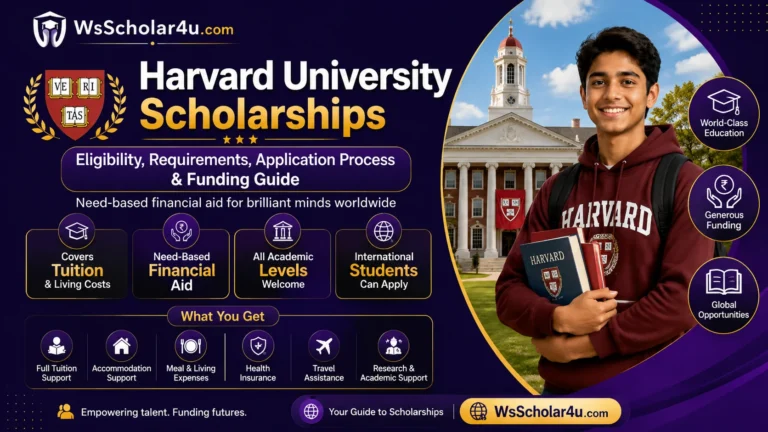
For a low-income international student, this policy can function as a full scholarship because the institution calculates the family contribution and covers the remaining demonstrated need. The amount is individualized rather than a fixed award. Harvard reviews income, assets, family size, expenses, and unusual circumstances, so applicants must provide accurate financial documentation and should use the current international aid instructions. Read here Harvard University Scholarships 2027: Eligibility, Requirements, Application Process & Funding Guide.
2. Yale University International Student Financial Aid
Yale is one of the leading U.S. options for international undergraduates who need substantial financial assistance. Yale’s official affordability information states that admission is need-blind and that aid offers meet 100% of demonstrated need regardless of citizenship or immigration status, without requiring loans. The international admissions information also describes allowances connected with housing, meals, and travel to and from campus.
Yale aid is not a universal merit prize that every admitted student receives. It is calculated from the family’s demonstrated need. Applicants must indicate that they want financial aid and submit the required forms by the relevant admission deadline. A student who waits until after admission to request aid may not receive the same consideration, so the financial-aid request should be planned together with the admission application. Read Yale University Scholarship 2026-27.
3. Princeton University Financial Aid for International Students
Princeton’s undergraduate financial-aid programme is another major full-funding route for international students. Princeton states that admission is need-blind and that it meets 100% of demonstrated financial need with grant aid. Its international policy says that the full need of admitted international students is met in the same way as for students from the United States.
The grant-based approach is important because the aid package is designed around need rather than a large loan requirement. Applicants should prepare complete income, asset, family, and tax information in the format Princeton requests. The university’s admission and financial-aid deadlines may differ by application plan, so international students should review the current 2027–28 checklist before submitting. Top 7 Fully Funded Scholarships for PhD students in USA 2027.
4. Massachusetts Institute of Technology Undergraduate Aid
MIT’s financial-aid mission is to make an MIT education affordable for every admitted student based on talent, regardless of financial circumstances. MIT calculates the cost of attendance, evaluates the family’s expected financial responsibility, and awards institutional grants and scholarships for the difference representing demonstrated need. The university uses detailed financial information and an individualized need-analysis process.
MIT is especially suitable for students with exceptional preparation in mathematics, science, engineering, computing, research, or interdisciplinary problem-solving, although applicants may pursue many fields. Full funding depends on the student’s calculated need and the official financial-aid offer. International applicants should submit all required parent and family financial information, including documents from non-U.S. systems when requested.
5. Amherst College International Financial Aid
Amherst College states that it is need-blind with respect to admission for international students, meets 100% of calculated financial need, and does not initially package student loans in its financial-aid offers. Amherst provides a comprehensive programme using scholarships and grants, student employment, and other aid for international and domestic students.
The Amherst opportunity is particularly valuable for students who cannot afford a U.S. liberal-arts education without substantial support. Applicants should understand that the university calculates need according to its own institutional methodology, which may differ from a family’s personal estimate. The student must request aid through the application process and submit the documents Amherst requires for international financial-aid assessment.
6. Dartmouth College International Undergraduate Aid
Dartmouth College meets the demonstrated need of all admitted undergraduates, including international students, and has expanded its need-blind admission policy to international citizens. The college states that international financial aid can include scholarships and loans as well as an allowance for travel to the United States. Its aid page also explains how student work contributions may apply after the first year.
Dartmouth’s full-need policy can make the college accessible to students whose families could not otherwise pay the total cost. However, full demonstrated need is based on Dartmouth’s assessment, not simply the amount an applicant reports. Students should accurately report family income and assets, understand any expected work contribution, and review the current aid application requirements before applying.
7. Bowdoin College International Student Aid
Bowdoin College states that it meets all admitted international students’ full demonstrated need with scholarships and a small on-campus work expectation. This means Bowdoin can provide a full-cost financial-aid package for an admitted international student whose documented need is high enough. The college explains that international applicants may submit financial-aid materials after admission under the current process, with instructions provided through the admission portal.
Because aid procedures can change by applicant year, students should not copy an older CSS Profile or ISFAA rule. Bowdoin’s current page specifies the financial-aid documents and deadlines applicable to each class. Applicants should also understand the exchange-rate policy when reporting income and assets in local currency.
8. Brown University International Financial Aid
Brown University allows international students to apply for financial aid and states that it meets the full demonstrated need of admitted students when they apply for aid at the time of admission. Brown’s aid is need-based rather than merit-based, and its official policy states that Brown is need-blind for international students beginning with the Class of 2029.
Brown aid is generally applied to tuition, fees, room, and meals, and can help with travel, books, and personal expenses. Brown cautions that the award does not cover vacation and summer expenses. International applicants should therefore create a separate budget for flights, deposits, winter or summer travel, health costs, and personal spending even when the regular academic-year package covers their demonstrated need.
9. University of Notre Dame International Undergraduate Financial Aid
The University of Notre Dame states that undergraduate admission for international applicants is need-blind and that need-based financial aid meets the full demonstrated need of domestic and international undergraduate students. Prospective first-year students who want aid must complete the CSS Profile and provide requested supporting documents through the College Board’s Institutional Documentation Service.
Notre Dame also offers a limited number of merit scholarships to admitted first-year students, with selection based on exceptional accomplishment, leadership, service, and intellectual promise. Need-based aid and merit aid can interact, so students should read the official policy carefully. For the 2027–28 cycle, the published priority dates include November 1, 2026 for Restrictive Early Action admission and January 1, 2027 for Regular Decision admission, with CSS Profile dates shortly afterward.
10. Duke University Karsh International Scholars Program
The Karsh International Scholars Program is a named full-cost opportunity for international students at Duke University. International applicants must demonstrate financial need, apply to Duke, and request financial aid; Duke states that there is no separate scholarship application. The programme covers tuition, room and board, mandatory fees, demonstrated need above those costs, and three summers of funding for research, unpaid internships, or other activities that advance the student’s academic career.
Karsh is different from the need-blind university aid programmes listed above because it is a named scholarship programme with a defined international scholar cohort. Applicants must be non-U.S. citizens without dual U.S. citizenship and must not already hold a bachelor’s degree. Strong academic preparation, documented financial need, intellectual engagement, and civic or global potential are important parts of the profile.
Students can also review the USA scholarships category for additional opportunities. External listings are useful for discovery, but applicants should verify whether each award is full or partial, open to international students, renewable, and available for the 2027 intake.
Scholarship Summary
The 10 opportunities differ in how funding is awarded. Harvard, Yale, Princeton, Amherst, Dartmouth, Bowdoin, Brown, and Notre Dame primarily provide institutional need-based aid after admission. MIT also calculates individualized need and awards institutional grants and scholarships. Duke Karsh is a named international scholarship that covers a broad full-cost package. The table below summarizes the central difference between each programme.
| Opportunity | Main funding model | International applicant position | Key coverage |
| Harvard College aid | Need-based institutional aid | Need-blind; same aid eligibility as U.S. students | 100% demonstrated need; no required loans |
| Yale aid | Need-based institutional aid | Need-blind | 100% demonstrated need; housing, meals, and travel allowances may be included |
| Princeton aid | Grant-based institutional aid | Need-blind | 100% demonstrated need with grant aid |
| MIT aid | Individualized need analysis | Aid based on family circumstances and institutional policy | Institutional grants and scholarships for demonstrated need |
| Amherst aid | Need-based institutional aid | Need-blind | 100% calculated need; no initially packaged loans |
| Dartmouth aid | Need-based aid | Need-blind for international citizens | Demonstrated need; scholarships, travel allowance, and work contribution rules |
| Bowdoin aid | Need-based scholarships and aid | Full need for admitted international students | Full demonstrated need with small on-campus work expectation |
| Brown aid | Need-based institutional aid | Need-blind for international students beginning Class of 2029 | Full demonstrated need; no merit awards |
| Notre Dame aid | Need-based plus limited merit | Need-blind for international admission | Full demonstrated need; CSS Profile and IDOC documents |
| Duke Karsh | Named full-cost scholarship | International applicants with demonstrated need | Tuition, room, board, fees, additional need, and three summers |
Scholarship Coverage
A fully funded undergraduate package may cover tuition, mandatory fees, room, meals, health insurance, books, personal expenses, transportation, and sometimes travel between the student’s home country and the United States. No single label guarantees the same benefits at every institution. The final financial-aid offer is the controlling document, and students should compare billed and unbilled costs before accepting an admission place.
Need-based aid is calculated from family income, assets, family size, expenses, country of residence, and other circumstances. A university may meet 100% of its calculated need while calculating that need differently from the applicant’s family. Named scholarships such as Duke Karsh can provide broader benefits, but they remain highly competitive and may require demonstrated financial need.
Students should also budget for visa fees, passport renewal, flights, health insurance requirements, winter clothing, deposits, personal travel, and costs during periods not covered by the academic-year award. Students who want to compare other international funding can read the international scholarships for college guide and the MPOWER Global Citizen Scholarship guide, although those resources concern different eligibility rules and study levels.
Eligibility Criteria
Applicants should meet the academic and personal requirements of the university as well as the financial-aid requirements. Most of these opportunities are open to first-year international applicants who have not completed a bachelor’s degree, but admission standards are extremely selective. A student can be financially eligible and still be denied admission, or be admitted but receive a different package because the university calculates need using its own methodology.
Strong applicants usually present challenging secondary-school coursework, excellent grades in context, meaningful extracurricular activity, intellectual curiosity, leadership, service, awards, research, work experience, or community impact. There is no universal GPA or test-score cutoff for all 10 opportunities. Universities assess the curriculum available at the applicant’s school and the context in which the student achieved results.
Applicants should also check English-language testing, SAT or ACT policies, application-platform requirements, recommendation letters, school reports, essays, interviews, portfolio requirements, and financial-aid documents. Some universities require a CSS Profile, an institutional form, tax records, non-filer statements, or translated documents. A request for aid must normally be made at the same time as the admission application.
Application Process
The most effective strategy is to prepare the admission and aid applications together. International students should begin 12 to 18 months before enrollment by researching universities, creating a balanced list, gathering financial documents, preparing tests, and confirming each institution’s aid policy. A full-need university is not a financial safety if admission is highly selective, so applicants should include realistic alternatives and investigate partial scholarships as well.
Step 1: Build a university list
Select institutions based on academic fit, intended major, campus environment, aid policy, and international eligibility. Separate need-blind full-need universities from need-aware colleges and named merit scholarships. Read the official policy carefully to determine whether requesting aid affects admission and whether the university promises to meet the full calculated need of admitted international students.
Step 2: Prepare academic evidence
Collect transcripts, predicted grades, school profiles, national examination results, curriculum explanations, recommendation letters, and translations when required. Do not convert grades into a U.S. GPA without instructions. Admissions offices evaluate international records in context and may request additional verification.
Step 3: Complete the admission application
Use the platform required by the university, such as the Common Application, Coalition Application, or a university-specific portal. Write authentic essays that explain the applicant’s experiences, questions, values, and contributions. Do not copy generic scholarship essays across institutions. Confirm whether testing is required, optional, or recommended for the 2027 cycle.
Step 4: Submit financial-aid forms
Complete the CSS Profile, institutional financial-aid form, ISFAA, IDOC documents, tax records, parent statements, and other requirements requested by the university. Report income and assets accurately in the requested currency. If the family cannot obtain a document, contact the financial-aid office before the deadline and follow its alternative-document procedure.
Step 5: Track deadlines
Create a spreadsheet containing the admission deadline, financial-aid deadline, CSS Profile date, IDOC deadline, testing date, recommendation status, and result date. Notre Dame’s current 2027–28 page, for example, lists different priority dates for Restrictive Early Action and Regular Decision. Other institutions may use different deadlines or separate international-aid procedures.
Step 6: Compare financial-aid offers
When admitted, compare the complete offer rather than only the scholarship title. Check tuition, fees, housing, meals, insurance, books, travel, work expectations, family contribution, renewal conditions, and summer coverage. Ask the financial-aid office for clarification before committing. Aid may be renewable annually, but continued eligibility depends on satisfactory academic progress and updated financial information.
Deadline Guidance for 2027
Most U.S. universities publish undergraduate deadlines between late summer and January for enrollment the following autumn, but the exact 2027 deadline depends on the application plan. Notre Dame’s current information lists November 1, 2026 for Restrictive Early Action admission, January 1, 2027 for Regular Decision admission, and CSS Profile priority dates of November 15, 2026 and January 15, 2027 respectively. Other universities should be checked individually.
| Planning period | Recommended action |
| Spring–Summer 2026 | Research universities, aid policies, tests, and intended majors |
| August–October 2026 | Prepare essays, recommendations, CSS Profile information, and early applications |
| November–December 2026 | Submit Early Action or Early Decision materials and required aid forms |
| January 2027 | Submit Regular Decision applications and financial-aid documents |
| February–April 2027 | Monitor portals, respond to document requests, and review decisions |
| April–May 2027 | Compare offers, confirm enrollment, and complete visa planning |
Apply Now
Start with the official financial-aid and admissions pages for the universities that match your profile. There is no single government application for these 10 opportunities. Applicants must apply to the university, request financial aid by the correct deadline, and submit the financial documents required by that institution. Use official websites rather than agents promising guaranteed admission or a guaranteed full ride.
Before submitting, confirm six points: the university accepts international first-year applicants; the intended programme is eligible; the applicant has not already completed a bachelor’s degree; financial aid is requested at admission; all forms and documents are complete; and the application deadline is verified for the 2027 cycle. A fully funded award is competitive, but careful preparation can prevent avoidable ineligibility.
Related Scholarships
 USA
USANational Merit Scholarship Program (2027) Complete Application Guide
 USA
USAHarvard University Scholarships 2027: Eligibility, Requirements, Application Process & Funding Guide
 Countries
The Hubert H. Humphrey Fellowship (2027) A Complete Guide and Requirements
 Countries
Labroots Back to School Scholarship (2027) Complete Details
 Countries
10 Best Educational Grants and Scholarships for Global Students 2027
 Countries
7 Top Scholarships for College to Achieve Success in 2027

