

Understanding the USA Scholarship Requirements is the first step toward securing financial support at an American university. International applicants may find scholarships for undergraduate, master’s, doctoral, research, athletic, artistic, and professional programmes. Each scholarship sets its own rules, so students must compare the award requirements with the university admission requirements.
The USA Scholarship Requirements 2027 can include academic grades, English-language scores, standardised tests, recommendation letters, a personal statement, proof of achievements, financial documents, and a valid passport. Some awards are merit-based. Others are need-based or linked to a specific subject, institution, nationality, or career goal.
This guide explains the USA Scholarship Requirements in 5 practical steps. It also links to relevant scholarship resources, including the USA scholarships category, the general scholarships category, and the scholarships by countries guide. Official external resources appear after this introduction.
What Are the USA Scholarship Requirements?
The main USA Scholarship Requirements are academic eligibility, English proficiency, complete application documents, a strong personal statement, and financial or visa evidence when required. International students may need to meet both scholarship conditions and university admission conditions.
The U.S. Department of Homeland Security states that prospective F-1 or M-1 students must show sufficient financial resources for tuition, books, living expenses, and travel before a school issues Form I-20. A scholarship letter can be part of that financial evidence, but the school decides which documents it accepts.
1. Check the Scholarship and University Eligibility Requirements
The first USA Scholarship Requirement is eligibility. Begin by selecting a degree level, academic subject, university, and scholarship type that match your profile. An undergraduate award may require a high-school qualification, while a graduate award may require a recognised bachelor’s degree. A doctoral fellowship may require a master’s degree, research proposal, publications, or supervisor support.
Academic Requirements
Universities and scholarship committees may review your grades, class rank, academic awards, relevant coursework, research experience, and professional achievements. Requirements can appear as a minimum GPA, percentage, degree classification, or equivalent qualification. Because grading systems differ by country, some universities request credential evaluations or official academic translations.
Prepare the following academic evidence:
1.Secondary-school certificate for undergraduate applications.
2.Bachelor’s degree and transcripts for master’s applications.
3.Master’s degree and research evidence for doctoral applications.
4.Academic awards, competition results, or professional certificates.
5.Course descriptions or credential evaluations when requested.
Do not assume that admission to a U.S. university automatically produces a full scholarship. Some universities offer need-based aid. Others offer merit awards, assistantships, tuition waivers, fellowships, or department funding.
Scholarship-Specific Eligibility
Read the nationality, age, field-of-study, degree-level, and enrolment conditions. For example, the NSF GRFP Fellowship guide is relevant to eligible graduate research applicants, while the Phi Theta Kappa Spring Cycle Scholarships target a different student group.
The Heinlein Society Scholarship and Sallie Mae $2,000 No-Essay Scholarship also have their own award rules. Treat each award as a separate application. Check whether the scholarship is open to international students, U.S. residents, current students, or applicants from a specific institution.
Use Official Scholarship Directories
EducationUSA provides a financial-aid and scholarship search resource for international students. Its official financial-aid page includes scholarship listings and guidance on financing U.S. study. Students can also use the EducationUSA advising-center directory to locate country-specific guidance.
2. Meet English-Language and Standardised-Test Requirements
The second USA Scholarship Requirement is proof that you can study successfully in English. Universities may accept IELTS, TOEFL iBT, PTE Academic, Duolingo English Test, or another approved test. The accepted test and minimum score depend on the university, programme, and applicant’s previous education.
Read our IELTS exam preparation guide before booking an examination. Do not select a test only because it is popular. Confirm that the university and scholarship accept it for the 2027 application cycle.
Common English-Language Documents
Applicants may need an official score report, test-registration number, English-medium instruction letter, or proof of education in an English-speaking system. A waiver is not automatic. Some universities allow waivers for applicants who completed a qualifying degree in English, while others still require a test.
For additional preparation, review the official TOEFL iBT information and the official IELTS test information. These are external test-provider resources, not scholarship guarantees.
SAT, ACT, GRE, and GMAT
Some undergraduate universities remain test-optional, test-flexible, or test-required. Graduate programmes may request the GRE, GMAT, LSAT, MCAT, or another subject-specific examination. Check the exact programme page before paying for a test.
A strong test score can support a merit scholarship, but it does not replace academic preparation, leadership, a well-written essay, or evidence of impact. Applicants should submit scores only when they strengthen the overall application or when the university requires them.
3. Prepare the Required Documents and Scholarship Essay
The third USA Scholarship Requirement is a complete and accurate document package. A missing transcript, unreadable scan, late reference, or incomplete form can make an application ineligible.
Core Documents
Most international scholarship applications request the following documents:
1.Passport or official identity document.
2.Academic transcripts and certificates.
3.Curriculum vitae or résumé.
4.English-language test score.
5.Standardised-test score when required.
6.Two or more recommendation letters when requested.
7.Personal statement or scholarship essay.
8.Research proposal for research-based programmes.
9.Portfolio for art, design, architecture, media, or performance programmes.
10.Financial-aid forms and supporting evidence.
Documents that are not in English may require certified translations. Use the spelling of your name consistently across your passport, transcript, application, and test records.
Write a Strong Scholarship Essay
A scholarship essay should explain your academic preparation, personal motivation, leadership, community contribution, career plan, and reason for choosing the programme. It should answer the exact question instead of repeating your CV.
Use our guide on how to write a winning scholarship essay to plan the structure. A clear essay usually contains a direct opening, specific evidence, a logical goal, and a conclusion that connects your plans to the scholarship’s mission.
Avoid unsupported claims such as “I am the best candidate.” Replace them with evidence, such as a project you completed, students you mentored, a business you created, research you conducted, or a measurable community result.
Recommendation Letters
Choose recommenders who know your academic, professional, research, or leadership work. Give each recommender your CV, transcript, scholarship description, essay draft, and deadline. Ask at least 4 weeks before the submission date.
4. Complete the Admission and Scholarship Application Correctly
The fourth USA Scholarship Requirement is submitting the correct application through the correct platform. Some scholarships require a separate form. Other awards consider every admitted student automatically. A university may use its own portal, the Common Application, Coalition Application, a graduate-school system, or a scholarship-provider platform.
For undergraduate applications, review the official Common App international applicant guidance. For graduate applications, use the university department or graduate-school portal named in the official instructions.
Check the Application Type
Before submitting, confirm the following details:
1.The scholarship accepts international applicants.
2.The award supports your degree level and field.
3.The university accepts your application route.
4.The deadline uses your local time or U.S. time zone.
5.The application requires a separate financial-aid form.
6.Recommendation letters have been received.
7.Test scores have been sent to the correct institution.
8.All required essays and uploads are complete.
Some U.S. scholarships require institutional nomination. Others require admission first. Research awards may require a faculty supervisor. The Clark Art Institute Fellowship illustrates why applicants should read programme-specific rules rather than rely on a general scholarship checklist.
Submit Before the Deadline
Create a personal deadline calendar for admission, scholarship, test scores, references, financial-aid documents, and visa preparation. Submit several days early when possible. Save your confirmation email, application number, uploaded essays, and payment receipt if a legitimate application fee applies.
5. Prove Financial Support and Prepare for the Student Visa
The fifth USA Scholarship Requirement is financial documentation. A scholarship applicant may need to show how tuition and living costs will be paid, especially after receiving admission.
The Department of Homeland Security explains that evidence of financial ability can include family bank statements, sponsor documents, financial-aid letters, scholarship letters, and an employer letter showing annual salary. The designated school official reviews the evidence before issuing Form I-20.
A full scholarship letter may satisfy some or all of the school’s financial-evidence requirement. A partial award may leave a remaining balance that must be supported by a sponsor, family funds, approved loan, or other accepted source. Contact the university’s international student office when you are unsure.
Student Visa Documents
After admission, international students generally need the university’s Form I-20 for an F-1 visa or the relevant document for another student category. Applicants must follow the official U.S. Department of State instructions for the student visa application.
You may need the following documents for the visa stage:
1.Valid passport.
2.Form I-20 or relevant exchange document.
3.DS-160 confirmation.
4.Visa appointment confirmation.
5.SEVIS fee receipt when required.
6.Admission letter.
7.Scholarship or financial-support letter.
8.Bank or sponsor evidence for any remaining cost.
9.Academic records and test results.
10.Evidence of your study plan and intent to follow visa rules.
A scholarship does not guarantee visa approval. The consular officer considers the applicant’s individual circumstances and documentation. Do not buy non-refundable travel before receiving the visa unless you understand the risk.
USA Scholarship Requirements for Different Study Levels
Undergraduate Students
Undergraduate applicants usually need a secondary-school certificate, transcripts, English-language proof, recommendations, essays, and proof of activities or achievements. Some universities require or recommend SAT or ACT scores. Need-based financial aid often requires a separate financial-aid form.
Master’s Students
Master’s applicants usually need a recognised bachelor’s degree, transcripts, CV, statement of purpose, recommendations, English scores, and programme-specific tests when required. Competitive funding may also require work experience, research evidence, or a portfolio.
PhD Students
PhD applicants usually need a relevant degree, research interests, a statement, academic references, writing samples or publications, and a potential supervisor or research fit. Funding may come from fellowships, teaching assistantships, research assistantships, grants, or department awards.
For more opportunities, visit the USA scholarships by country category and browse the wider scholarships category.
USA Scholarship Requirements Checklist
Before submitting a 2027 application, confirm that you have completed these checks:
1.You meet the scholarship’s nationality and degree-level rules.
2.Your academic record satisfies the minimum requirement.
3.Your English-language test is accepted and valid.
4.Your passport and translations are ready.
5.Your CV and personal statement match the scholarship purpose.
6.Your recommenders have submitted their letters.
7.Your financial-aid forms are complete.
8.Your scholarship and university deadlines are recorded.
9.Your application portal shows a submitted status.
10.You have saved proof of submission.
How to Meet USA Scholarship Requirements in 2027
To meet the USA Scholarship Requirements 2027, choose an eligible programme, satisfy the academic and English requirements, prepare accurate documents, submit the scholarship and admission forms on time, and prove financial support for the visa process. Requirements vary by institution, so use the official scholarship call and university website as your final source.
Start early, write a specific essay, request recommendations in advance, and verify every financial document. Students can also explore the USA scholarship resources and related opportunities through the scholarships by countries page.
Important: No single requirement applies to every USA scholarship. Always read the official scholarship call and the university’s admission page before applying.
Related Links
- AMVETS Scholarship 2027 (Complete Guide)
- Folded Flag Foundation Scholarship (2027) Complete Guide
- UH Scholarships (2027) Guide to University of Houston Financial Aid
- Freeman-ASIA Scholarship 2027 (Complete Application Guide)
Related Scholarships
 Application Documents
How to Write a Winning Scholarship Essay 2027?
 Application Documents
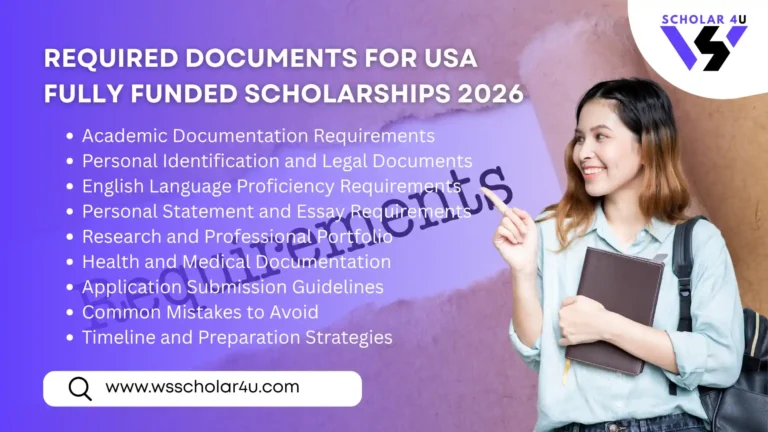
Required Documents for USA Fully Funded Scholarships 2027
 Blogs
BlogsWhat is scholarship thank you letter? Basic Structure & Purpose 2027?
 Application Documents
Requirements for Fully Funded Scholarships for International Students 2027
Application DocumentsApplication Documents List for Scholarships 2027 (International Students)

