

Paul & Daisy Soros Fellowship 2027: Eligibility, Benefits, Deadline, and Application Guide
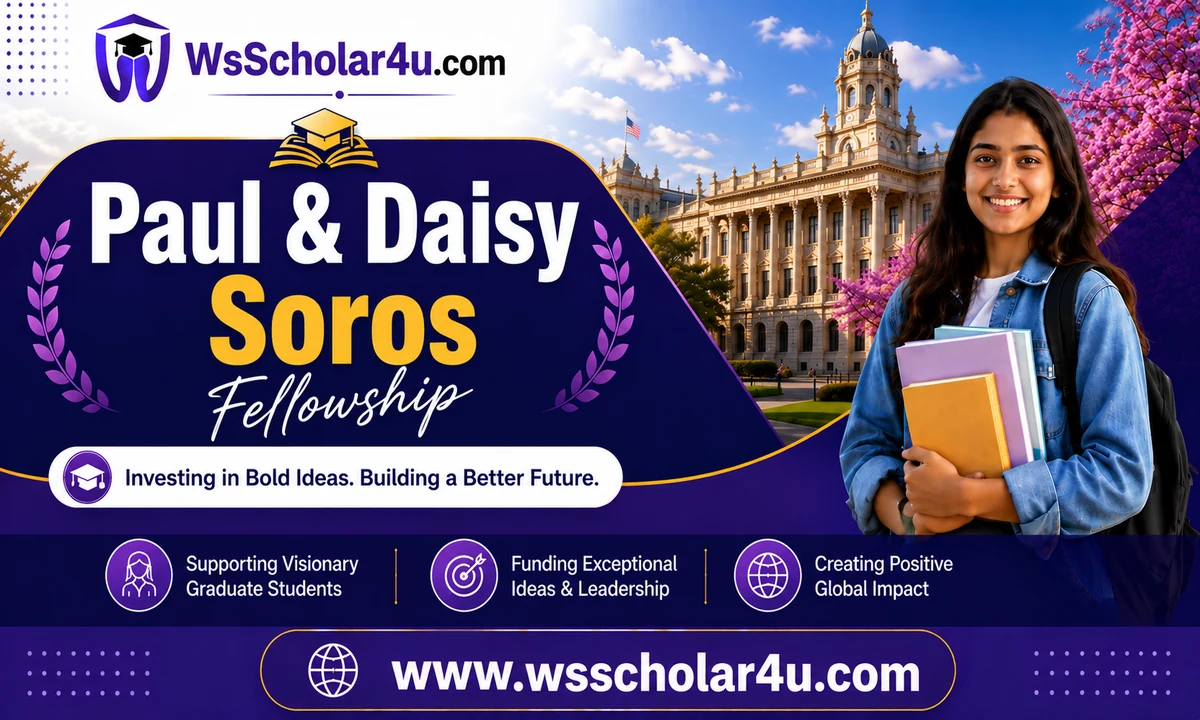
The Paul & Daisy Soros Fellowship 2027 supports New Americans who plan to begin or continue full-time graduate or professional study in the United States. The program selects 30 immigrants or children of immigrants and provides up to $90,000 in support over 1–2 years. The 2027 application deadline is October 29, 2026, at 2:00 p.m. Eastern Time.
Graduate students often face 2 major problems: tuition costs and the need to explain a complex personal, academic, and immigrant story in a competitive application. The Paul & Daisy Soros Fellowship addresses both problems through tuition support, a direct stipend, and a holistic review process. The program accepts applicants from all fields and does not set a preferred GPA or test-score range. Financial-support research also links fellowships and other forms of aid with graduate student retention, which shows why funding can affect a student’s ability to remain focused on a demanding degree.
This guide explains the Paul & Daisy Soros Fellowship 2027 using official program information and research-based context. It is designed to help applicants solve the most common application challenges: proving New American eligibility, selecting the correct graduate program, writing 2 focused essays, registering 3–5 recommenders, submitting transcripts and test scores, and meeting the exact deadline. The information reflects the official 2027 requirements available when this article was prepared.
Scholarship Summary
The Paul & Daisy Soros Fellowship for New Americans is a merit-based graduate fellowship for immigrants and children of immigrants. It supports full-time, degree-granting graduate and professional programs at accredited institutions in the United States. Applicants may apply while seeking admission or during the first 2 years of the graduate program they want the Fellowship to fund.
| Field | Details |
| Scholarship name | Paul & Daisy Soros Fellowship for New Americans 2027 |
| Level of study | Graduate and professional study |
| Location | United States |
| Institution(s) | Accredited U.S. institutions offering eligible full-time graduate or professional degrees |
| Program period | 2027–2028 academic year; funding begins in Fall 2027 |
| Courses offered | All fields of graduate and professional study |
| Number of Fellows | 30 New Americans |
| Maximum award | Up to $90,000 over 1–2 years |
| Stipend support | Up to $25,000 per year for up to 2 years, paid to the Fellow |
| Tuition support | Up to $20,000 per year for up to 2 years, paid directly to the university |
| Age requirement | 30 or younger on October 29, 2026; no minimum age |
| Deadline | October 29, 2026, at 2:00 p.m. Eastern Time |
| Finalist interviews | February 2027, conducted virtually |
| Fellowship announcement | April 2027 |
The Fellowship does not restrict applicants to one academic discipline. Eligible fields may include medicine, law, engineering, social science, humanities, public policy, business, computer science, education, and other professional or graduate areas. The graduate program must be full-time, degree-granting, and located at an accredited U.S. institution during the 2027–2028 academic year.
Students researching major STEM awards can also read the Regeneron Science Talent Search guide. Regeneron has different eligibility and research requirements, so applicants should use it as a separate funding resource rather than combine its rules with the Paul & Daisy Soros Fellowship.
Scholarship Coverage
The Paul & Daisy Soros Fellowship provides up to $90,000 in financial support over 1–2 years. The published benefit includes up to $25,000 per year in stipend support paid directly to the Fellow and up to $20,000 per year in tuition support paid directly to the university. The exact amount and duration depend on the Fellow’s eligible graduate study and the program’s funding rules.
The stipend can help cover living costs that tuition awards do not address. These costs may include housing, food, transportation, books, health-related expenses, and other ordinary student needs. Tuition support reduces the amount charged by the university. Applicants should still review their graduate school’s financial-aid policy because outside fellowships can affect institutional grants, assistantships, or other awards.
Coverage also includes two all-expenses-paid weekends in New York City during the first 2 years of the Fellowship. The program director visits each new Fellow on campus, and Fellows join a national alumni network connected by shared immigrant experiences and professional achievement. These program features provide community and visibility in addition to direct financial aid.
Students planning a health-related career may compare this award with the Tylenol Future Care Scholarship information. The Tylenol program has separate requirements and should not be treated as part of Paul & Daisy Soros Fellowship coverage.
The first year of the Fellowship cannot be deferred. Applicants should therefore apply only when their graduate-study timeline matches the 2027–2028 funding period. A student who delays enrollment should contact the Fellowship program and review the current rules before assuming that the award can move to a later year.
Eligibility Criteria
Applicants must meet 3 core eligibility conditions by the deadline: they must be 30 or younger, they must qualify as a New American, and they must plan to enroll in an eligible full-time graduate or professional program in the United States during the 2027–2028 academic year. Every condition must be true on October 29, 2026.
Age requirement
The applicant must be 30 or younger on the application deadline. The 2027 deadline is October 29, 2026, at 2:00 p.m. Eastern Time. The program does not set a minimum age. Applicants should calculate their age on the deadline, not on the date they begin graduate school or the date the Fellows are announced.
New American requirement
A New American is an immigrant or the child of immigrants. The official eligibility page identifies several pathways for immigrant applicants. An immigrant applicant may qualify as a naturalized U.S. citizen, green-card holder, asylee, or refugee. A person who graduated from both high school and college in the United States may also qualify under the stated New American pathway. Applicants should read the official definitions carefully because documentation may be requested if they become finalists.
Graduate or professional study requirement
The applicant must plan to enroll full-time in a degree-granting graduate or professional program in the United States during the 2027–2028 academic year. The program supports all fields of study at accredited institutions. A student may apply while applying to graduate school or while enrolled in the first 2 years of the academic program for which funding is requested. A future career goal without a qualifying graduate program does not satisfy this requirement.
Academic and selection profile
The Fellowship does not use a preferred GPA or test-score range for eligibility. Its merit-based review considers the applicant’s achievements in context. The program looks for creativity, originality, initiative, sustained effort, accomplishment, commitment to constitutional and civic values, promise of future contributions, and a clear connection between graduate training and long-term goals.
Applicants who need a graduate research funding comparison can review the GEM Fellowship guide. GEM has different field, degree, and eligibility rules, so students should compare both programs without transferring one program’s requirements to the other.
Required evidence
Applicants must provide information about their education and New American background. They must submit a resume or CV, transcripts, 2 essays, and 3 recommendations. The application accepts up to 5 recommendations. Standardized test scores are required when the graduate program required those scores for admission. Optional exhibits may help applicants show an important project, publication, performance, invention, or other achievement, but exhibits do not replace the required materials.
Application Process
The Paul & Daisy Soros Fellowship application is completed online through the official application system. Applicants create an account, answer eligibility and demographic questions, describe their educational and New American background, identify graduate programs, upload required materials, and register recommenders. The application is free, and every recommendation must be submitted through the current application system by the same deadline.
Step 1: Confirm eligibility before drafting
Check age, New American status, graduate-program status, enrollment timing, and U.S. institution requirements before investing time in the essays. The official website provides an eligibility quiz, but applicants should read the full eligibility page because the quiz does not replace documentation. If selected as a finalist, the applicant must provide evidence supporting the eligibility answers.
Step 2: Identify the graduate program to fund
List the graduate or professional programs that match the requested Fellowship year. Explain the degree, institution, field, and expected enrollment date. Applicants may apply before receiving an admission decision, but they must clearly explain why they selected the programs. The application provides space for multiple graduate programs, and applicants should use consistent names and dates across the form, resume, and essays.
Step 3: Prepare the New American essay
Essay One has a maximum length of 1,000 words. It asks applicants to explain their experiences as New Americans and how those experiences shaped their identity, accomplishments, and choices. A strong response uses specific events, people, institutions, laws, cultural experiences, or family circumstances. It should connect the applicant’s background to demonstrated action and achievement rather than provide a general statement about immigration.
The essay should answer 3 questions: What experience shaped the applicant? What action did the applicant take? What result or lesson connects that experience to future work? Avoid turning the essay into a resume. The selection committee already receives a resume, so Essay One should provide context that cannot be understood from dates and job titles alone.
Step 4: Prepare the career and graduate-study essay
Essay Two also has a maximum length of 1,000 words. It asks applicants to explain current and near-term career activities and goals, why they selected particular graduate programs and schools, and how current work or study informs early career plans. Applicants who have not yet been admitted should explain why they selected the programs to which they are applying.
The response should connect past preparation, graduate training, and future contribution. State the problem or field the applicant wants to address. Name the skills or knowledge the degree will provide. Explain why the selected program is necessary. End with a practical description of the contribution the applicant plans to make after training.
Step 5: Upload the resume or CV
The program does not set a page limit for resumes or CVs. A clear 1–2 page resume is common, but applicants may use a longer CV when their academic, research, professional, artistic, or community record requires it. Use headings such as education, research, employment, publications, leadership, awards, service, and presentations. Include dates, roles, organizations, and measurable results.
Step 6: Submit transcripts and test scores
Upload college and graduate transcripts as required by the application. An unofficial transcript image can be used initially when it includes the applicant’s name and institution name. Finalists must provide official documents if the program requests them. Upload the official score report or an acceptable screenshot for standardized tests that the graduate program required. Do not upload self-created documents that merely list scores.
If an applicant has not taken a required graduate admission test by the deadline, the application provides a way to indicate that the test will be taken later. The applicant should follow the current instructions and submit scores when available. The test requirement follows the graduate program’s admission rules, so applicants should not upload unrelated scores merely to add documents.
Step 7: Register 3–5 recommenders
Register at least 3 and no more than 5 recommenders in the application system. Choose people who can explain the applicant’s achievements, choices, character, and potential. Recommenders may include professors, research mentors, supervisors, employers, community leaders, or other people with direct knowledge of the applicant’s work.
Ask recommenders early and send them the essay prompts, resume, graduate-program information, and deadline. A recommendation signed by multiple people counts as 1 letter if it is submitted as one recommendation. Each recommender must be registered separately, and all recommendations must arrive by October 29, 2026, at 2:00 p.m. Eastern Time. Previous recommendations cannot be transferred to the new application.
Step 8: Add optional exhibits carefully
Optional exhibits can show achievements that the resume and essays cannot explain fully. An exhibit may include a research paper, publication, design, performance, invention, artwork, policy document, or other work. Select exhibits that support the application’s central story. Do not upload unrelated files because quantity does not replace relevance.
For technical works created with other people, explain the applicant’s specific contribution. The selection committee needs to understand what the applicant personally designed, wrote, tested, organized, or accomplished. Label each file clearly and check that the file opens before submission.
Step 9: Proofread and complete the online application
Review every field for consistent dates, degree names, institution names, immigration terminology, and contact information. Check the 2 essays against the 1,000-word hard limit. Confirm that every transcript, score report, recommender registration, and optional exhibit is attached to the correct section. The application must be submitted online, and the program makes no exceptions to the 2:00 p.m. Eastern Time deadline.
Students comparing advanced research fellowships can read the Hertz Fellowship guide. Hertz supports a different population and degree pathway, but comparing award timing and application materials can help applicants build a complete graduate-funding calendar.
Step 10: Prepare for finalist review
The program will identify the top 77 applicants as finalists. All applicants are expected to receive finalist-status notifications in mid-January 2027. The 77 finalists will participate in virtual interviews in February 2027. Thirty finalists will be selected as Fellows and notified in March 2027. The 2027 Fellows will be announced publicly in April 2027, and funding begins in Fall 2027.
The finalist stage requires careful preparation. Review the essays, resume, graduate goals, New American story, and exhibits. Practice explaining one important achievement in 2 versions: a short answer of 30 seconds and a detailed answer of 2 minutes. The goal is not to memorize a speech. The goal is to present a consistent, accurate, and personal account of the applicant’s preparation and future contribution.
Deadline
The Paul & Daisy Soros Fellowship 2027 deadline is October 29, 2026, at 2:00 p.m. Eastern Time. The program states that it makes no exceptions to this deadline. Applicants must submit their own application and ensure that all 3–5 recommendations arrive by the same date and time. A draft saved in the online system is not a completed submission.
Applicants should use a 4-stage preparation calendar. The first stage confirms eligibility and graduate-program information. The second stage drafts and revises both essays. The third stage collects transcripts, test scores, resume materials, exhibits, and recommendations. The fourth stage submits the application at least 48 hours early and checks that all recommendation statuses show as complete.
The official timeline lists finalist notifications for mid-January 2027, virtual interviews in February 2027, Fellow notifications in March 2027, public announcement in April 2027, and fellowship funding beginning in Fall 2027. Applicants should save these dates because selection does not end at the application deadline.
Students planning future research careers may also review the NSF GRFP Fellowship guide. NSF GRFP is a separate graduate fellowship with different eligibility and application rules, so applicants should use it for long-term planning rather than copy its requirements into a PD Soros application.
Apply Now
Apply through the official Paul & Daisy Soros Fellowship 2027 application portal. Before submitting, confirm that you meet the age, New American, graduate-enrollment, full-time-study, and U.S. institution requirements. Upload the resume, transcripts, required test scores, 2 essays, and any optional exhibits. Register 3–5 recommenders and confirm that each recommendation is submitted by October 29, 2026, at 2:00 p.m. Eastern Time.
Use the official Paul & Daisy Soros Fellowship application process page to review current instructions, essay prompts, required documents, finalist dates, and program updates. If a question involves immigration documentation, graduate-program status, or a possible exception, contact the Fellowship organization directly before submitting rather than relying on an unofficial summary.
Related Links
- Top 8 Fully Funded Scholarships for Pakistani Students 2027
- Top Scholarships | Masters Scholarships | Fully Funded Scholarships
- Undergraduate Scholarships | Scholarships 2027
Related Scholarships
 Scholarships
Davidson Fellows Scholarship 2027: Eligibility, Benefits, Deadline, and Application Guide
 Countries
France Excellence Eiffel Scholarship (2027) A Complete Guide
 Countries
The Hubert H. Humphrey Fellowship (2027) A Complete Guide and Requirements
 Countries
Labroots Back to School Scholarship (2027) Complete Details
 Countries
10 Best Educational Grants and Scholarships for Global Students 2027
 Countries
7 Top Scholarships for College to Achieve Success in 2027

