Konrad Adenauer Scholarship 2027: €992–€1,400, No IELTS
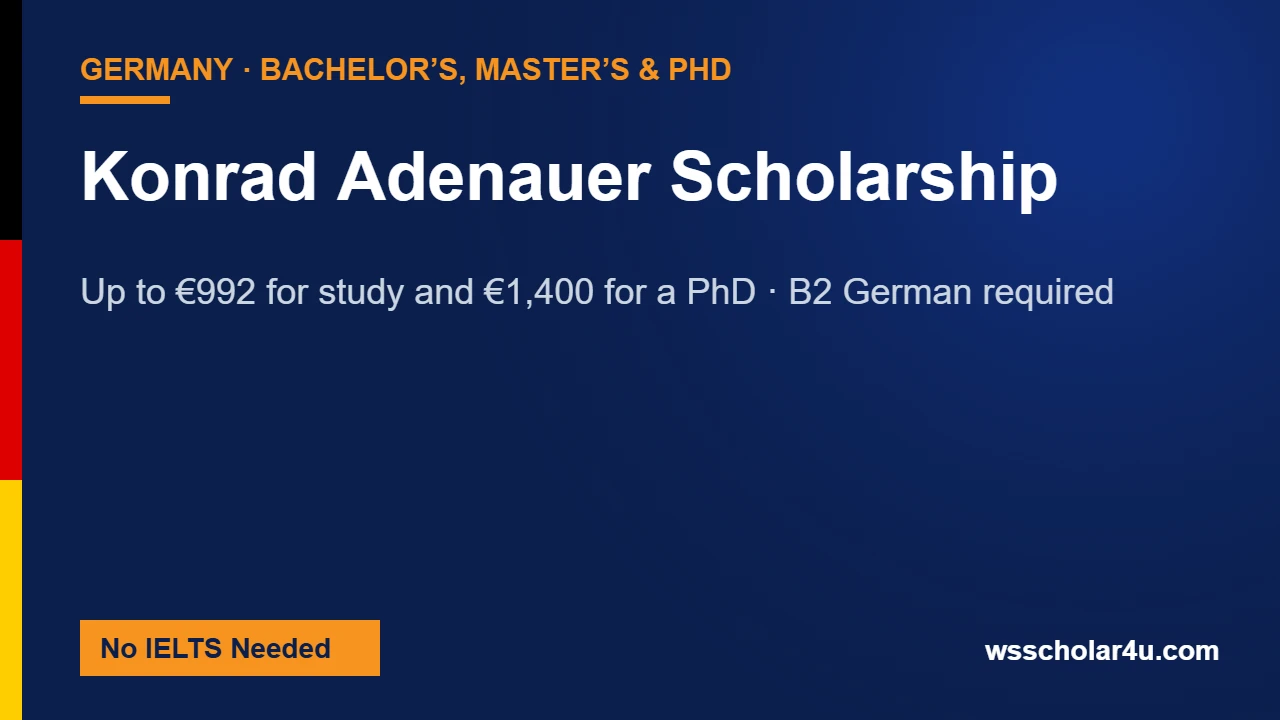
Can I get the Konrad Adenauer scholarship without IELTS if my master’s in Germany is taught in English? Students ask this because the foundation funds international students at bachelor’s, master’s and PhD level, and many of them only hold an English-medium degree. The honest answer is that IELTS is not the hurdle here. German is. The foundation expects at least B2 German from every scholar, even in English-taught programmes.
The Konrad-Adenauer-Stiftung (KAS) is a German political foundation guided by Christian democratic values. Its international scholarship pays up to €992 a month to bachelor’s, master’s and postgraduate students and up to €1,400 a month to doctoral candidates, plus allowances for health insurance and family. About 300 scholars from more than 50 countries are funded at present. There is no age limit, and the programme mainly targets applicants from outside the EU.
Status: upcoming. Applicants already living in Germany apply through the KAS Campus portal by 15 July 2027 at 12:00 noon (CET). Applicants abroad can only apply through the KAS offices taking part that year, so check the current list first. Bachelor’s students must finish two semesters in Germany before applying. This guide follows the official KAS international scholarship page, checked on 29 November 2026.
Scholarship Summary
- Scholarship name: Konrad-Adenauer-Stiftung International Scholarship Program
- Country: Germany
- Provider: Konrad-Adenauer-Stiftung (KAS)
- Level of study: Bachelor’s (from the 2nd semester), master’s, postgraduate and PhD
- Monthly stipend: Up to €992 (study) or up to €1,400 (doctorate)
- Duration: At least four semesters; usually two years for study and three years for a PhD
- English test: Not required by KAS
- German: Minimum B2 by the start of studies
- Age limit: None
- Application status: Upcoming
- Deadline: 15 July 2027, 12:00 noon CET (in-country route)
Do You Need IELTS for the Konrad Adenauer Scholarship?
No. The KAS international page lists no IELTS or TOEFL requirement. What it does require is German at B2 level or higher, for example a Goethe-Institut certificate. KAS says most scholars pass the DSH or present a high TestDaF score. This rule applies even if your degree is taught fully in English, because the seminar programme runs in German.
Keep two things apart. KAS sets the German rule, but your university still sets its own admission language rule. If you plan an English-taught master’s, check whether the programme accepts your English-medium degree. Our guide to Germany scholarships without IELTS shows how to check that. If B2 German is not realistic for you, the DAAD PhD scholarship and Hungary postgraduate scholarships are worth comparing.
What Does the Konrad Adenauer Scholarship Cover?
The stipend covers living costs. Extra allowances are paid on request when you qualify:
- Monthly stipend: Up to €992 for bachelor’s, master’s and postgraduate study; up to €1,400 for a doctorate
- Health insurance subsidy: Up to €120 per month
- Family allowance: €276 if your spouse lives in Germany for more than three months
- Child allowance: €250 per child, with documents
- Research travel: Grants for research trips abroad (conference visits are excluded)
- Tuition: In exceptional cases, up to €750 per semester is reimbursed
- Not covered: Enrolment, re-registration and exmatriculation fees, such as the semester ticket and student union fee
The scholarship also includes seminars, a scholar network and university group meetings, which KAS treats as part of the award.
Who Is Eligible for the KAS International Scholarship?
KAS lists 9 main eligibility rules on its international page:
- You are an international student or doctoral candidate, mainly from a non-EU country.
- Bachelor’s applicants have completed at least two semesters of a bachelor’s programme at a German university.
- Master’s applicants intend to enrol in a four-semester master’s programme in Germany. You may apply before finishing your first degree.
- Doctoral applicants are fully admitted to a doctoral programme at a German university. Postdocs are not funded.
- Universities of applied sciences (HAW/FH) are included.
- You have at least B2 German by the start of your studies.
- You have above-average academic results.
- You show social or political engagement and support democratic values.
- Your field is not human medicine, dentistry (state exam) or medical specialist training. Three-semester programmes, such as some LL.M. degrees, are generally not eligible.
What Do You Need to Apply?
KAS keeps its full checklist in a German “Notes on Applying” document. Its international page confirms 3 core requirements:
- Proof of strong academic performance.
- Proof of German at B2 level or higher.
- Evidence of volunteering or civic engagement, ideally in your home country.
Required Documents (5):
- Academic transcripts.
- Degree certificate, once available (for master’s and postgraduate applicants who have not yet graduated).
- Letters of recommendation, in German or English, or in the original language with a German translation.
- German language certificate (B2 or higher).
- Dissertation proposal, preferably in German, or in English if your PhD will be written in English (doctoral applicants only).
Grades from outside Germany are easier to judge once converted. Try our GPA converter before you write your application.
How to Apply for the Konrad Adenauer Scholarship
There are 5 steps, and the first one takes the longest.
Step 1: Reach B2 German
Book a recognised exam such as Goethe, TestDaF or DSH early. KAS expects B2 by the start of your studies.
Step 2: Secure your study place
Doctoral applicants need full admission to a German doctoral programme. Master’s applicants need a four-semester programme. Bachelor’s students apply after their second semester.
Step 3: Choose your route
If you live in Germany, use the in-country route. If you live abroad, check whether your local KAS office takes part this year on the official KAS international scholarship page. For 2026, KAS listed regional interviews with its offices in Buenos Aires and Nairobi.
Step 4: Submit on KAS Campus
Upload your documents on the KAS Campus portal before 15 July at 12:00 noon (CET).
Step 5: Selection
KAS looks at academic results, commitment to democratic values, volunteering, initiative and motivation. Shortlisted candidates are invited to selection interviews.
Konrad Adenauer Scholarship Deadline
Application Deadline: 15 July 2027, 12:00 noon (CET)
This is the yearly deadline for the in-country route. Regional interviews abroad follow their own dates, which KAS announces on its website. Save the date in our scholarship deadline calendar.
Frequently Asked Questions
Here are short answers to what students ask most about KAS.
Can I apply from Pakistan, India or Nigeria?
Only through a KAS office that runs a selection that year, or through the in-country route once you live in Germany. Check the current list on the KAS website before you plan.
Can my PhD be in English?
Yes. You may write your proposal in English if your thesis will be in English, but the B2 German rule still applies.
Is there an age limit?
No. KAS says there is no age limit for its international programme.
Are there similar foundations?
Yes. The Heinrich Böll Foundation scholarship and the Friedrich Ebert Foundation scholarship also fund international students and also look at social commitment. If you want short professional training instead of a degree, Australia Awards Short Courses are a different route.
Plan Your Application With Free Tools
Use the Find Scholarships tool on our home page to filter Germany and “Without IELTS”. You can also explore all our tools, such as the eligibility checker and the study abroad cost calculator.
Related Scholarships
- Germany Scholarships Without IELTS 2027: 6 Real Options
- Deutschlandstipendium 2027: €300 a Month Without IELTS
- Heinrich Böll Foundation Scholarship 2027 Apply Now
- Friedrich Ebert Foundation Scholarship 2027: Stipend Guide
- Fully Funded Scholarships in Germany 2027
Related Scholarships
 France
 Scholarships Without IELTS 2027: 5 Real Options
 France
Emile Boutmy Scholarship 2027: Up to €18,500, No IELTS
 France
IP Paris PhD Track 2027: €10,000 Scholarship, No IELTS
 France
Ecole Polytechnique Master’s Scholarships 2027, No IELTS
 France
Charpak Scholarship 2027–28 for Indian Students, No IELTS
 Germany
DAAD PhD Scholarship 2027–28: €1,400 a Month, No IELTS

