
Germany Scholarships Without IELTS 2027: 6 Real Options
Which Germany scholarships without IELTS can I actually apply for? Students search this after noticing that many English-taught programmes in Germany ask for a test score. The good news is that several German scholarships never ask for IELTS at all. Some judge your English through your degree, and others care about German instead. The catch is that each one sets its own rule, so you need to read them closely.
We found six options whose rules we could confirm on their official pages. Three are open to bachelor’s students, four fund master’s study and four support a PhD. Funding ranges from €300 a month under the Deutschlandstipendium to €1,400 a month under the DAAD PhD grant. Most public universities in Germany charge no tuition, but your degree programme still decides which language proof it accepts, so you need to check both.
Status: mixed. The Friedrich Ebert Foundation’s master’s deadline for the winter semester is 30 November 2026, and Humboldt-Universität zu Berlin’s Deutschlandstipendium window runs until 6 December 2026. Heinrich Böll and Konrad Adenauer deadlines follow in March, July and September 2027. Every fact in this list of Germany scholarships without IELTS comes from official scholarship pages, checked on 29 November 2026.
Can You Study in Germany Without IELTS?
Often, yes, but two different rules apply. The scholarship has its own language rule, and your degree programme has a separate admission rule. A scholarship that asks for no IELTS does not help if your programme still demands one.
Programmes differ a lot. TUM accepts a bachelor’s degree as proof of English when more than half of it was taught in English. Some LMU biology master’s programmes say a medium of instruction (MOI) certificate is not enough. German-taught degrees ask for TestDaF or DSH instead. Our Scholarships Without IELTS finder helps you compare options across countries.
6 Germany Scholarships Without IELTS
Here are the six Germany scholarships without IELTS that we verified. For each one, we list the level, the money, the language rule and the next deadline, with a link to our full guide.
1. Deutschlandstipendium (Bachelor’s and Master’s)
- Amount: €300 a month, usually for two semesters
- Language rule: No English test for the scholarship; documents in German or English are accepted at many universities
- Deadline: Set by each university, for example 9 November to 6 December 2026 at HU Berlin
- Full guide: Deutschlandstipendium for international students
2. DAAD Doctoral Programmes in Germany (PhD)
- Amount: €1,400 a month, a €460 yearly research allowance and insurance payments
- Language rule: IELTS and TOEFL are not listed among the required documents
- Deadline: Depends on your country of residence; the portal opens on 1 June
- Full guide: DAAD PhD scholarship without IELTS
3. Max Planck Research Schools (PhD)
- Amount: Usually an employment contract, such as 65% or 75% of the E13 public-sector scale
- Language rule: Six schools accept an English-medium degree or other proof instead of a test
- Deadline: Different for each school
- Full guide: Max Planck PhD without IELTS
4. Konrad-Adenauer-Stiftung (Bachelor’s, Master’s and PhD)
- Amount: Up to €992 a month for study and up to €1,400 for a doctorate
- Language rule: No IELTS, but German at B2 level is required
- Deadline: 15 July 2027, 12:00 noon CET, for applicants living in Germany
- Full guide: Konrad Adenauer scholarship
5. Friedrich Ebert Foundation (Bachelor’s and Master’s)
- Amount: €992 a month plus health insurance; €255 extra per month for students with a child
- Language rule: Very good German is needed, even for English-taught programmes; B2 is accepted
- Deadline: Master’s: 30 November for the winter semester and 31 May for the summer semester. Bachelor’s: after the first semester
- Full guide: Friedrich Ebert Foundation scholarship
6. Heinrich Böll Foundation (Master’s and PhD)
- Amount: €992 a month for international students from outside the EU
- Language rule: German at B2 or DSH 1, with proof
- Deadline: 1 March and 1 September each year
- Note: Böll has posted a notice for master’s students that from 1 March 2027 it will only accept applications for a first degree, so check this before planning
- Full guide: Heinrich Böll Foundation scholarship
Which Option Fits Your Study Level?
- Bachelor’s: Deutschlandstipendium, Friedrich Ebert (after your first semester) and Konrad Adenauer (after your second semester)
- Master’s: Deutschlandstipendium, Konrad Adenauer, Friedrich Ebert and Heinrich Böll
- PhD: DAAD Doctoral Programmes, Max Planck Research Schools, Konrad Adenauer and Heinrich Böll
Which Scholarships Need German Instead of IELTS?
This is the part most guides skip. The three political foundations, Konrad Adenauer, Friedrich Ebert and Heinrich Böll, do not ask for IELTS, but they all expect German at B2 level, because their seminars run in German. If you have no German yet, the DAAD PhD grant, the Max Planck schools and the Deutschlandstipendium are the realistic Germany scholarships without IELTS for you.
How to Prove English Without IELTS
Use these 4 kinds of proof, in this order of strength:
- A transcript or degree certificate that states English as the language of instruction.
- An official MOI letter from your university, signed by the registrar or an academic teacher.
- An English-language thesis or a set number of English-taught credits, where the programme allows it.
- A paper you wrote in English, or proof that you lived or worked in English, which some Max Planck schools accept.
How to Apply
Every programme has its own portal, but the order of work is the same, in 4 steps.
Step 1: Choose your degree and check its language rule
Use your university’s own language page, for example the TUM Language Skill Navigator.
Step 2: Match a scholarship to your level
Use the list above. If you speak German, add the foundations; if not, focus on the DAAD, Max Planck and Deutschlandstipendium.
Step 3: Prepare your documents
Collect your MOI letter, transcripts and recommendation letters early. Convert your grades with our GPA converter.
Step 4: Apply before each deadline
For example, the Friedrich Ebert Foundation page for international students lists its master’s dates.
Upcoming Deadlines
- 30 November 2026: Friedrich Ebert Foundation, master’s (winter semester)
- 6 December 2026: Deutschlandstipendium at HU Berlin
- 1 March 2027: Heinrich Böll Foundation
- 31 May 2027: Friedrich Ebert Foundation, master’s (summer semester)
- 15 July 2027, 12:00 noon CET: Konrad Adenauer Foundation
- 1 September 2027: Heinrich Böll Foundation
Keep them in one place with our scholarship deadline calendar.
Frequently Asked Questions
Short answers to the questions we get most about Germany scholarships without IELTS.
Is it free to study in Germany?
At most public universities, bachelor’s and master’s study is tuition-free, although Baden-Württemberg charges non-EU students €1,500 per semester. See our list of countries with free tuition for international students.
Which countries besides Germany accept an MOI letter?
Several do. Compare scholarships in Italy without IELTS, Hungary postgraduate scholarships and research options such as the Singapore International Pre-Graduate Award.
What if I want an MBA?
The Deutschlandstipendium and the foundations fund many master’s programmes, so check your MBA’s eligibility with each one. If you are open to other countries, compare Australia MBA scholarships for international students.
Plan Your Application With Free Tools
Use the Find Scholarships tool on our home page with Germany and “Without IELTS” selected, or explore all our tools, such as the study abroad cost calculator and the eligibility checker.
Related Scholarships
- Scholarships in Italy Without IELTS 2027–28
- Australia Scholarships Without IELTS 2027 (Fully Funded)
- Fully Funded Scholarships in Germany 2027
- Scholarships in Germany 2027 (Complete Guide)
- Germany Master’s Scholarships 2027 — Funding by Program
Related Scholarships
 France
 Scholarships Without IELTS 2027: 5 Real Options
 France
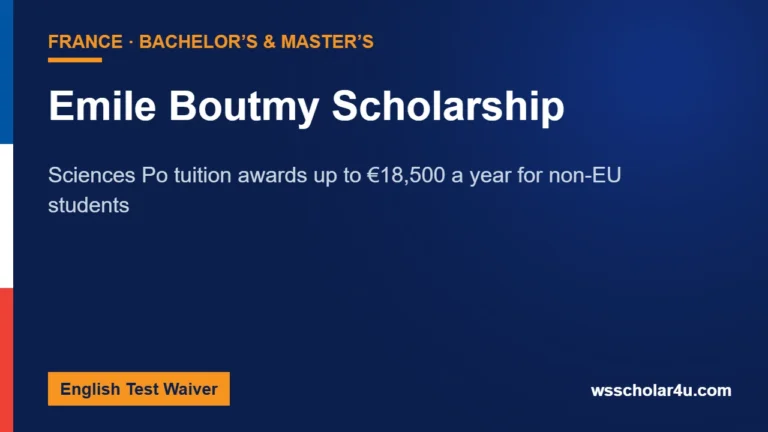
Emile Boutmy Scholarship 2027: Up to €18,500, No IELTS
 France
IP Paris PhD Track 2027: €10,000 Scholarship, No IELTS
 France
Ecole Polytechnique Master’s Scholarships 2027, No IELTS
 France
Charpak Scholarship 2027–28 for Indian Students, No IELTS
 Germany
DAAD PhD Scholarship 2027–28: €1,400 a Month, No IELTS

