

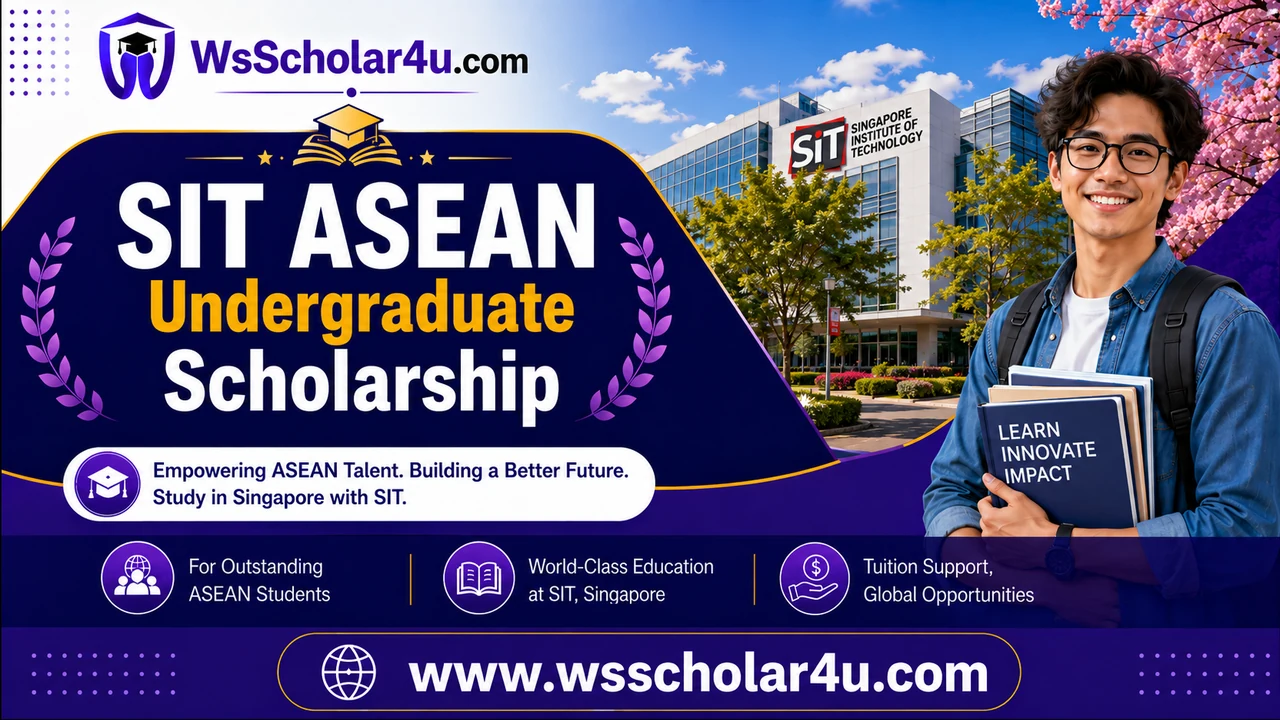
The SIT ASEAN Undergraduate Scholarship 2027 is a competitive freshmen scholarship for outstanding students from ASEAN countries, excluding Singapore, who want to pursue a full-time undergraduate degree at the Singapore Institute of Technology. The award includes subsidised tuition fees, a living allowance of S$5,800 per year, an accommodation allowance of S$3,000 per year, and a one-time laptop allowance of S$1,750.
Many ASEAN students face the same central problem: a strong academic record may secure university admission, but the cost of tuition, accommodation, food, transport, technology, insurance, and daily living can still make overseas study difficult. Students may also struggle to understand the difference between SIT’s scholarship, the MOE Tuition Grant, partner-university programmes, and other Singapore funding options. Confusing these arrangements can lead to an unrealistic budget or a missed application requirement.
This complete guide provides the solution by explaining the scholarship from beginning to end. It covers the eligible ASEAN nationalities, SIT’s available degree programmes, partner universities, scholarship coverage, Tuition Grant bond, academic and co-curricular requirements, application documents, selection process, 2027 timeline, renewal rules, and the financial responsibilities that remain after the award. The 2027 dates are marked carefully because the latest official admissions guide reviewed for this article provides the previous cycle’s dates rather than a final 2027 schedule.
Why the SIT ASEAN Undergraduate Scholarship Matters
The SIT ASEAN Undergraduate Scholarship is designed for students who demonstrate more than examination performance. SIT specifically looks for outstanding high-school results, leadership qualities and potential, and a good record of co-curricular activities. It is therefore a strong fit for students who can connect academic readiness with community contribution, teamwork, initiative, service, competitions, projects, or other evidence of potential.
A major pain point is that many applicants describe themselves only through grades. High grades are important, but they do not automatically show leadership, resilience, communication, problem-solving, or the ability to contribute to an applied-learning environment. The practical solution is to present achievements with context: explain the challenge, the action taken, the measurable result, the lesson learned, and how the experience connects to the selected SIT programme.
Another pain point is assuming that “subsidised tuition” means all study costs are paid. The scholarship provides important financial support, but students should still budget for costs not expressly covered, including personal expenses, books, travel, medical needs, and any remaining tuition or fees. The MOE Tuition Grant also creates a three-year work obligation for international students and Singapore Permanent Residents who accept the grant.
Scholarship Summary
The following summary presents the core facts of the SIT ASEAN Undergraduate Scholarship for applicants planning to enter SIT in 2027. The scholarship is a freshmen award, meaning students must apply for admission to an eligible full-time SIT undergraduate degree. Scholarship consideration takes place through the admissions process rather than through a completely separate open competition for all graduates.
| Category | SIT ASEAN Undergraduate Scholarship 2027 |
| Institution | Singapore Institute of Technology (SIT) |
| Scholarship type | Freshmen undergraduate scholarship |
| Eligible nationality | Citizens of ASEAN member countries excluding Singapore |
| Study level | Full-time undergraduate degree |
| Tuition benefit | Subsidised tuition fees |
| Living allowance | S$5,800 per annum |
| Accommodation allowance | S$3,000 per annum |
| Laptop allowance | One-time S$1,750 |
| Bond under scholarship | No bond attached to the scholarship itself |
| Tuition Grant condition | Required to receive the scholarship; international students and PRs accepting it incur a three-year work obligation |
| Renewal requirement | Minimum CAP of 3.5 or equivalent and good conduct, reviewed every semester |
| Application route | SIT undergraduate admissions application; eligible applicants are considered and shortlisted through admissions |
| Current outcome guidance | Shortlisted scholarship outcomes are communicated by mid-July under the current scholarship page |
| 2027 deadline | To be confirmed in the official SIT 2027 admissions guide |
The scholarship is not automatically awarded to every eligible applicant. SIT reserves the right not to award a scholarship if it does not identify candidates of sufficient merit, and the selection committee’s decision is final. Applicants should therefore prepare a strong admission application even though scholarship consideration occurs alongside admissions.
Students who are still comparing undergraduate funding routes can review the Singapore international pre-graduate award for an earlier research-oriented study stage. That award is not a replacement for the SIT ASEAN Undergraduate Scholarship; it is included as a comparison resource for students planning different academic pathways.
Scholarship Coverage
The SIT ASEAN Undergraduate Scholarship provides four clearly stated benefits: subsidised tuition fees, an annual living allowance, an annual accommodation allowance, and a one-time laptop allowance. Together, these benefits can substantially reduce the financial pressure of studying in Singapore, but the actual remaining cost depends on the programme, accommodation arrangement, lifestyle, and any fees not covered by the scholarship or Tuition Grant.
The S$5,800 annual living allowance is intended to help with ordinary living expenses, while the S$3,000 annual accommodation allowance helps with housing costs. The S$1,750 laptop allowance is paid once rather than every year. Students should confirm the payment schedule, administrative conditions, and any changes in the award letter received from SIT.
The scholarship requires recipients to take up the MOE Tuition Grant. Singapore citizens receive the Tuition Grant automatically without a bond obligation, but international students and Singapore Permanent Residents must apply for the grant and sign a Grant Agreement. Under SIT’s current tuition information, they must work for a Singapore entity for three years immediately after graduation.
| Cost or support area | How the applicant should plan |
| Tuition | Reduced through the applicable government subsidy and scholarship terms |
| Living expenses | Supported by S$5,800 per year, but students should prepare a personal budget |
| Accommodation | Supported by S$3,000 per year; actual housing cost may be higher or lower |
| Laptop | One-time allowance of S$1,750 |
| Books and materials | Confirm programme-specific costs and budget separately |
| Transport and food | Budget separately from the published scholarship amounts |
| Visa or immigration costs | Confirm applicable costs and responsibilities with SIT |
| Medical and personal expenses | Keep an emergency reserve and review insurance arrangements |
| Post-graduation obligation | Three-year work obligation in Singapore for international students and PRs who accept the Tuition Grant |
The scholarship also cannot normally be combined with another scholarship, fellowship, bursary, grant, award, or allowance without prior approval from SIT. Students should disclose other funding rather than assuming that multiple awards can be added together.
For students comparing research and postgraduate opportunities after an undergraduate degree, the A*STAR Graduate Scholarship may be relevant at a later stage. It is a separate graduate-level route and should not be represented as part of the SIT ASEAN award.
Eligibility Criteria
The official SIT eligibility criteria identify four central elements: nationality, academic performance, personal potential, and admission status. Applicants must be citizens of an ASEAN member country other than Singapore, possess outstanding high-school results, show strong leadership qualities and potential, demonstrate a good co-curricular activity record, and apply for a full-time undergraduate degree programme at SIT.
The ASEAN member countries listed by SIT are Brunei Darussalam, Cambodia, Indonesia, Lao PDR, Malaysia, Myanmar, the Philippines, Singapore, Thailand, Timor-Leste, and Vietnam. Since Singapore is excluded from this scholarship, eligible applicants generally come from the other ten countries listed. Applicants should use their citizenship rather than their place of residence as the main reference point and confirm any special status directly with SIT.
| Eligibility area | Requirement or practical interpretation |
| Citizenship | Must be a citizen of an eligible ASEAN country excluding Singapore |
| Academic record | Outstanding high-school results |
| Leadership | Strong leadership qualities and potential |
| Co-curricular record | Good CCA record with meaningful involvement or achievement |
| Admission | Must apply for a full-time SIT undergraduate degree |
| Study stage | Freshmen applicants entering an undergraduate programme |
| Conduct | Good conduct required for scholarship renewal |
| Academic renewal | CAP of at least 3.5 or equivalent every semester |
| Other funding | No concurrent award without prior university approval |
SIT does not publish one universal minimum high-school percentage for the ASEAN Undergraduate Scholarship on the current scholarship page. Applicants should not invent a fixed grade cutoff. Instead, they should meet the academic entry requirements of the selected programme and present the strongest available results, qualifications, achievements, and personal statement.
A student whose grades are good but whose activities are limited should not assume that the application is impossible. The solution is to explain responsibility and impact in ordinary experiences: leading a group project, organizing a community activity, supporting a family business, mentoring younger students, completing technical work, participating in competitions, or overcoming a significant educational challenge can all provide useful evidence when documented honestly.
Available ASEAN Countries
The scholarship is intended for students from ASEAN countries outside Singapore, but nationality alone does not create eligibility. Applicants must also meet SIT’s admission requirements for the selected programme. The following table summarizes the country rule as it appears in the official scholarship information.
| Country or territory listed by SIT | Scholarship position |
| Brunei Darussalam | Eligible nationality category |
| Cambodia | Eligible nationality category |
| Indonesia | Eligible nationality category |
| Lao PDR | Eligible nationality category |
| Malaysia | Eligible nationality category |
| Myanmar | Eligible nationality category |
| Philippines | Eligible nationality category |
| Singapore | Excluded from this scholarship |
| Thailand | Eligible nationality category |
| Timor-Leste | Eligible nationality category |
| Vietnam | Eligible nationality category |
Applicants with dual nationality, permanent-resident status, or unusual citizenship documentation should contact SIT before submitting. The scholarship page uses citizenship as the central eligibility condition, and the admissions team can clarify how a particular passport or educational background should be recorded.
Available SIT Undergraduate Programmes
SIT describes its undergraduate degrees as programmes designed around the needs of growing industries. The current official programme directory includes degrees delivered by SIT alone and collaborative programmes delivered with overseas university or specialist education partners. Programme availability, intake, admission requirements, duration, and fees can change, so applicants should verify the 2027 programme page before ranking choices.
The available programmes span accountancy, aviation, computing, engineering, health and social sciences, food technology, hospitality, media, design, supply chain, nursing, and built-environment disciplines. Many conventional programmes run for three or four years and carry 180 or 240 credits, while selected programmes use different durations or competency-based pathways.
Business, accounting, communication, and management
Applicants interested in commercial, organizational, or communication careers can consider Accountancy, Business and Infocomm Technology, Communication and Digital Media, Digital Supply Chain, Hospitality and Tourism Management, and Integrated Studies in Technology and Management with a Supply Chain specialization. These programmes are suitable for students who want to connect business decisions with technology, logistics, communication, or service industries.
Computing, digital technology, and interactive media
Technology-focused options include Applied Artificial Intelligence, Applied Computing (Fintech), Applied Computing through the Competency-based Stackable Micro-credential pathway, Computer Engineering, Computing Science, Information and Communications Technology (Information Security), Information and Communications Technology (Software Engineering), Computer Science in Interactive Media and Game Development, Computer Science in Real-Time Interactive Simulation, Digital Art and Animation, Robotics Systems, and User Experience and Game Design.
Engineering, infrastructure, and transport
Engineering options include Aircraft Systems Engineering, Chemical Engineering, Civil Engineering, Electrical and Electronic Engineering, Electrical Power Engineering, Electronics and Data Engineering, Engineering Systems, Infrastructure and Systems Engineering, Mechanical Design and Manufacturing Engineering, Mechanical Engineering, Naval Architecture and Marine Engineering, Pharmaceutical Engineering, Sustainable Built Environment, and Sustainable Infrastructure Engineering. Some programmes are delivered with partner universities and may include distinct academic or study-location requirements.
Health, nursing, science, and nutrition
Health-related programmes include Diagnostic Radiography, Dietetics and Nutrition, Food Technology, Nursing, Nursing (Pre-registration and Specialty Training), Occupational Therapy, Physiotherapy, Radiation Therapy, Speech and Language Therapy, and related pharmaceutical or food-science disciplines. Health programmes may have programme-specific screening, aptitude, health, or professional requirements, so applicants should read the individual programme page carefully.
Culinary, food, and hospitality programmes
SIT’s directory also includes Food Business Management (Baking and Pastry Arts) and Food Business Management (Culinary Arts), delivered with The Culinary Institute of America, as well as Food Technology and Hospitality and Tourism Management. Applicants should confirm the exact campus, course length, practical-training requirements, and partner-institution conditions before ranking these programmes.
Partner Universities and Institutions
SIT’s programme directory identifies several partner universities and specialist institutions. These partnerships are important because the degree may be delivered jointly, academically validated by a partner, or structured around a partner’s curriculum and study requirements. A scholarship applicant must understand that selecting a collaborative degree can involve different programme expectations from selecting a degree delivered entirely by SIT. Students who want to compare this opportunity with awards in other countries or study levels can also browse the broader scholarships category, then return to the official SIT page to confirm the programme-specific conditions.
| Partner university or institution | Examples of related SIT programmes |
| DigiPen Institute of Technology Singapore | Computer Science in Interactive Media and Game Development; Computer Science in Real-Time Interactive Simulation; Digital Art and Animation; User Experience and Game Design |
| Newcastle University | Electrical Power Engineering; Mechanical Design and Manufacturing Engineering; Naval Architecture and Marine Engineering |
| Technical University of Munich | Chemical Engineering; Electronics and Data Engineering |
| University of Glasgow | Civil Engineering; Computing Science; Mechanical Engineering; Nursing |
| The Culinary Institute of America | Food Business Management in Baking and Pastry Arts; Food Business Management in Culinary Arts |
The partner institution does not change the scholarship’s core eligibility rule, but the selected programme may have additional academic prerequisites, interviews, aptitude tests, portfolio requirements, or professional standards. Applicants should read the SIT programme page and any linked partner information before choosing a programme as a first preference.
Students interested in other Singapore undergraduate routes can also compare the NTU Nanyang Scholarship. It is a separate university scholarship with its own eligibility criteria, award structure, and application process, so it should be used for comparison rather than combined with the SIT ASEAN scholarship.
Application Process
SIT uses an admissions-led scholarship process. Eligible students applying for a full-time undergraduate degree are considered and shortlisted through the undergraduate admission application. This means the personal statement, programme ranking, academic records, CCA information, and achievement evidence must all be prepared as scholarship materials even if the applicant does not see a completely separate scholarship application at the beginning.
Step 1: Research SIT programmes
Review the official undergraduate programme directory and identify up to five programmes that match your interests, academic background, strengths, and career direction. SIT states that programme-choice order matters. If an applicant receives an offer for the first-choice programme, the applicant will not be considered for subsequent choices.
Step 2: Check programme-specific requirements
Read the admission requirements for each selected degree. Confirm subject prerequisites, academic qualifications, English-language requirements where applicable, portfolios, interviews, aptitude assessments, health requirements, and partner-university conditions. Do not assume that meeting the scholarship criteria automatically means meeting the admission requirements.
Step 3: Prepare the admission application
Prepare accurate academic qualifications, high-school results, transcripts, identity information, CCA records, competition details, leadership evidence, work or internship experience, and a personal statement. SIT’s application guide advises applicants to highlight achievements and salient points that demonstrate passion and aptitude.
Step 4: Write a strong personal statement
The personal statement should explain why the applicant wants the chosen programme, what preparation has already been completed, which experiences demonstrate leadership or initiative, and how the applicant hopes to contribute to the SIT community and industry. Avoid generic claims such as “I am hardworking.” Replace them with a specific example and an outcome.
Step 5: Submit through the SIT application portal
Submit the undergraduate application during the official admissions period. The current guide shows that the 2026 application window ran from January 8 to March 19, 2026. The 2027 window should be confirmed in the next official guide. Eligible applicants are considered for the SIT ASEAN Undergraduate Scholarship through the admission process.
Step 6: Prepare for interviews or screening
If shortlisted for a programme, applicants may be invited to an admission interview or screening between February and May under the current admissions pattern. The format may differ by programme. Bring original educational certificates and transcripts when requested, understand the selected programme, and be ready to explain academic motivation, personal experiences, teamwork, leadership, and future goals.
Step 7: Monitor scholarship communications
Shortlisted scholarship candidates are informed of scholarship outcomes by mid-July under the current scholarship page. Applicants should monitor the email address and admissions portal used in the application. A scholarship offer may be issued alongside or after the programme admission outcome, and the applicant should read every condition before accepting.
Step 8: Accept the offer and complete matriculation
Successful applicants normally accept the SIT offer during the stated acceptance period, complete matriculation declarations, submit financial-aid documents where required, and follow medical or administrative instructions. The exact 2027 acceptance and matriculation dates will be published by SIT.
Documents Required
Applicants should prepare their documents before the application portal opens because missing information can weaken both admission and scholarship consideration. The exact document list depends on the applicant’s qualification system and chosen programme, but the scholarship page specifically emphasizes CCA records, achievements, and a personal statement within the admissions application.
| Document or evidence | Purpose |
| Passport or citizenship document | Confirms identity and ASEAN nationality |
| High-school certificate and results | Demonstrates academic eligibility |
| Official transcripts | Supports qualification assessment |
| CCA record | Demonstrates sustained participation and contribution |
| Competition or award evidence | Verifies achievement and performance |
| Leadership evidence | Shows initiative, responsibility, and impact |
| Personal statement | Explains programme fit, motivation, and future goals |
| Recommendation or supporting letter, if requested | Provides independent evidence of potential |
| Portfolio, where programme-specific | Demonstrates creative, technical, or practical ability |
| Original documents | May be required at interview or matriculation |
Applicants should use consistent spellings of names and dates across documents. If certificates are not in English, confirm whether an official translation or verification is required. Keep digital copies and original documents in an organized folder.
Deadline for the 2027 Intake
The final SIT ASEAN Undergraduate Scholarship deadline for the 2027 intake should be confirmed through the official SIT admissions guide when published. The current official application guide reviewed for this article provides a 2026 admissions window from January 8 to March 19, 2026, with interviews from mid-February to mid-May, outcomes from mid-April to mid-May, and offer acceptance in May or June. These dates are a planning reference, not a confirmed 2027 deadline.
The scholarship page states that shortlisted candidates are informed of scholarship outcomes by mid-July. Applicants should not wait for a separate scholarship deadline if scholarship consideration is built into the admissions process. Submit the complete undergraduate application by the official admission closing date and include CCA records, achievements, and the personal statement from the beginning.
| Stage | Current planning reference | 2027 status |
| Undergraduate application | January 8–March 19, 2026 in current guide | 2027 dates to be announced |
| Interviews or screening | Mid-February–mid-May under current guide | Confirm in 2027 guide |
| Admission outcomes | Mid-April–mid-May under current guide | Confirm in 2027 guide |
| Offer acceptance | May–June under current guide | Confirm in 2027 guide |
| Scholarship outcome | By mid-July for shortlisted candidates under current page | Confirm in 2027 communication |
| Matriculation | June in current guide | Confirm in 2027 instructions |
Scholarship Renewal and Conditions
The scholarship is monitored and renewed every semester. To continue receiving the award, the scholar must maintain a Cumulative Average Point of at least 3.5 or equivalent and demonstrate good conduct. Renewal is not automatic merely because the student received the scholarship at admission; academic performance and conduct must remain satisfactory.
Recipients may not concurrently hold another scholarship, fellowship, bursary, grant, award, or allowance without prior approval from SIT. Students should report other funding before accepting it. If a scholar withdraws from the university or terminates the scholarship prematurely, SIT reserves the right to require repayment of all scholarship monies disbursed.
SIT also states that it does not guarantee employment after graduation. International students and Singapore Permanent Residents who take the MOE Tuition Grant incur a three-year work obligation with a Singapore-registered company after graduation, but this is not a job placement promise. Students should understand both the financial benefit and the post-graduation responsibility before accepting the funding.
Main Student Pain Points and Practical Solutions
The first pain point is financial uncertainty. Students may see the word “scholarship” and assume that all costs are covered. The solution is to create a full cost-of-attendance budget containing tuition after subsidy, accommodation after allowance, food, transport, books, technology, personal expenses, insurance, travel, and emergency funds. Compare that budget with the exact award letter rather than a social-media summary.
The second pain point is weak programme selection. Some students rank a programme because it sounds popular without checking prerequisites, duration, partner-university arrangements, or career fit. The solution is to compare up to five choices carefully and rank them intentionally because SIT states that the order of choices matters.
The third pain point is an activity list without evidence. Writing “member of a club” does not show leadership or impact. The solution is to describe the role, responsibilities, duration, result, and lesson learned. Upload or retain certificates, recommendation letters, competition results, project outputs, and other evidence where the application permits.
The fourth pain point is deadline confusion. Applicants may rely on a prior year’s dates or wait for a separate scholarship form. The solution is to monitor the SIT admissions guide, apply within the undergraduate admission window, and confirm the scholarship process through SIT’s official admissions communication.
Frequently Asked Questions
Is the SIT ASEAN Undergraduate Scholarship fully funded?
The scholarship provides subsidised tuition fees, S$5,800 per year for living expenses, S$3,000 per year for accommodation, and a one-time S$1,750 laptop allowance. It is a substantial funding package, but applicants should confirm which costs remain payable and should not describe every personal expense as covered.
Who can apply?
Citizens of ASEAN member countries excluding Singapore can apply if they also have outstanding high-school results, strong leadership potential, a good CCA record, and an application for a full-time SIT undergraduate degree. The scholarship is a freshmen award.
Do I need a separate scholarship application?
Eligible students are considered and shortlisted through their SIT undergraduate admission applications. Applicants should include their CCA records, achievements, and personal statement in the admission application and follow any later instructions from SIT.
What CAP is needed to renew the scholarship?
The scholarship page states that recipients must maintain a CAP of at least 3.5 or equivalent and good conduct. SIT reviews the award every semester.
Does the scholarship include a bond?
The scholarship itself has no bond attached, but recipients must take the MOE Tuition Grant to receive it. International students and Singapore Permanent Residents who accept the Tuition Grant must work for a Singapore-registered company for three years after graduation.
Does SIT guarantee a job after graduation?
No. SIT expressly states that it does not guarantee or provide employment to scholars after graduation. Students should plan their employability, internships, skills, and career search independently.
Can I hold another scholarship at the same time?
Not without prior approval from SIT. The scholarship terms state that recipients may not concurrently hold another scholarship, fellowship, bursary, grant, award, or allowance without approval.
Are all SIT programmes eligible?
The scholarship is for applicants to full-time undergraduate degree programmes at SIT, but programme-specific admission rules and intake availability apply. Always confirm the selected programme in the official 2027 directory.
Apply Now
Applicants should begin with the official SIT undergraduate admissions portal and select programmes that match their academic background, interests, aptitude, and career plans. Include accurate high-school results, CCA information, leadership achievements, a carefully written personal statement, and any programme-specific supporting material. Scholarship consideration takes place through the admissions process for eligible applicants.
Official scholarship information
Before applying, confirm the 2027 opening and closing dates, programme availability, admission requirements, Tuition Grant procedure, scholarship conditions, required documents, and acceptance deadline. Use official SIT channels rather than agents promising guaranteed selection.
The SIT ASEAN Undergraduate Scholarship is a strong opportunity for eligible ASEAN students who want an applied, industry-connected undergraduate education in Singapore. The award’s value comes from the combination of subsidised tuition, annual living and accommodation support, and the laptop allowance, but applicants must also understand the Tuition Grant work obligation, renewal CAP, no-concurrent-funding rule, and absence of a guaranteed job.
The best preparation is to begin early: compare the available SIT programmes, investigate partner-university arrangements, organize documents, record CCA and leadership evidence, write a specific personal statement, and monitor the 2027 admissions guide. The current official pages provide a reliable planning basis, but the final 2027 deadlines and programme details must be confirmed directly with SIT when the new cycle is published.
Students seeking other Singapore scholarship options can also explore the Lee Kong Chian Scholarship for comparison. It is a separate award and does not change the eligibility or conditions of the SIT ASEAN Undergraduate Scholarship.
Related Links
- A*STAR International Fellowship – Research 2027 | Fully Funded Postdoctoral Fellowship
- Fully Funded Scholarships Guide All around the World
- Paul & Daisy Soros Fellowship 2027: Eligibility, Benefits, Deadline, and Application Guide
- Hertz Fellowship (2027) Application Process, Eligibility, and Benefits
Related Scholarships
 Singapore
A*STAR International Fellowship – Research 2027 | Fully Funded Postdoctoral Fellowship
 USA
USAHagan Scholarship 2027–28: Eligibility, Benefits, Deadline, and Application Guide
 Countries
Labroots Back to School Scholarship (2027) Complete Details
 Countries
10 Best Educational Grants and Scholarships for Global Students 2027
 Countries
7 Top Scholarships for College to Achieve Success in 2027
 Countries
Sitaram Jindal Scholarship 2027 Application Guide

